How to write YouTube scripts faster: the 90-minute system
How long does a YouTube script take you?
And I mean the whole thing, not just the writing time. I'm counting the doc you opened on Tuesday, closed again, reopened on Thursday, rewrote on Sunday, and finally recorded from while ignoring half of what you'd written.
For most part-time creators the honest answer sits somewhere between four hours and "I stopped counting." And when I ask people what actually took so long, the answer is never typing speed, because nobody types for four hours straight. It's everything that happens around the typing.
This post walks you through the system I use to get a script from idea to read-aloud-ready in about 90 minutes of writing time. It isn't a list of tips, and it isn't a replacement for the complete scripting system; it's the same structure run against a stopwatch. It's one system with five steps, each with a clock on it, and I'll demonstrate the whole thing start to finish on a single example topic so you can watch it work.
Why scripts actually take forever
Before the system makes sense, you need to see what's actually eating your hours. There are three culprits, and once you can name them, the fix becomes almost obvious.
The first is the blank page. You open a doc with a topic in mind but no structure, which means the first hour goes to deciding what the video even is. That isn't writing. That's planning, and you're doing it in the most expensive possible place, which is the middle of a sentence.
The second is the linear lock. You write from top to bottom, so you can't start section four until sections one through three feel finished. One stubborn paragraph ends up blocking the entire script behind it.
The third is editing in place. You write a sentence, dislike it, and rewrite it. Then you rewrite it again, and maybe five more times after that. You're polishing your first idea instead of finding your best one, and an hour quietly disappears into a paragraph that was never the real problem.
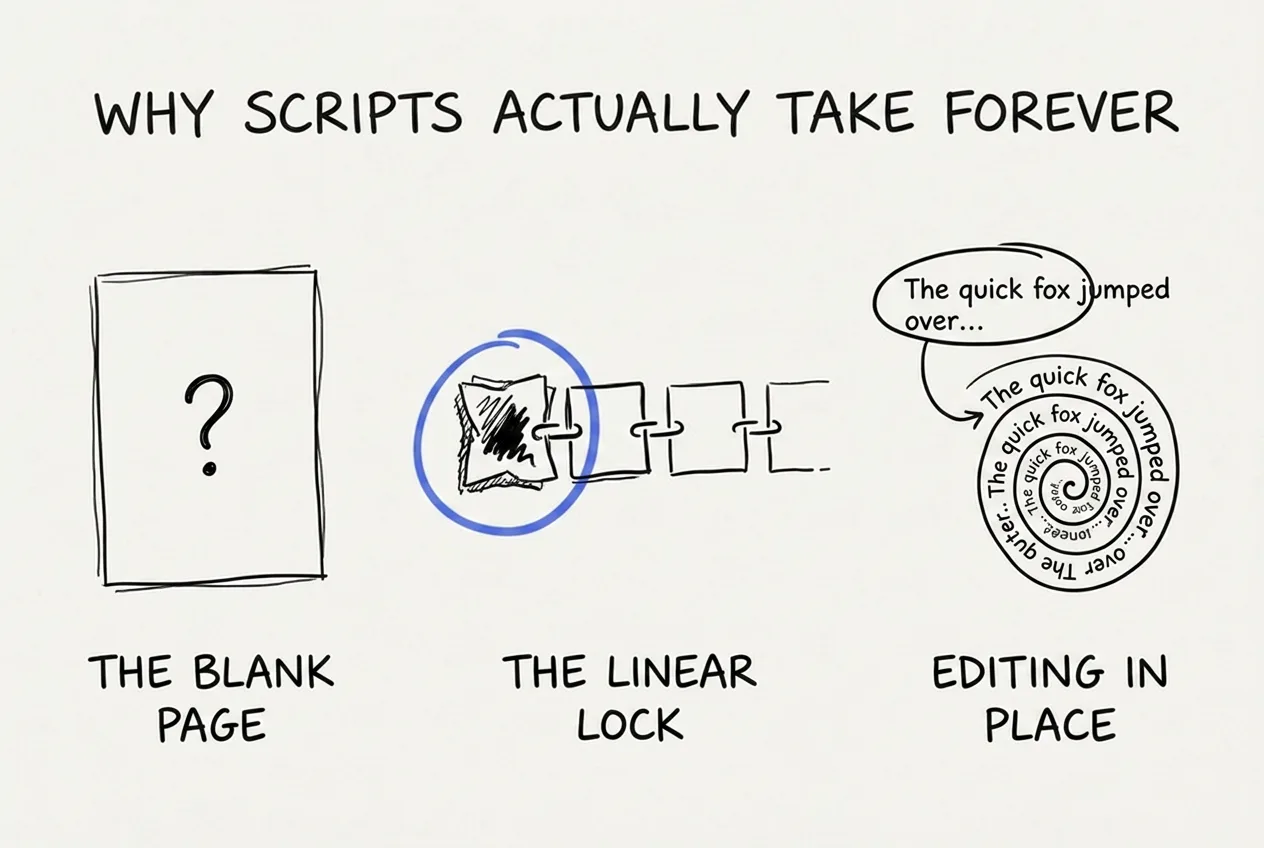
The three culprits. Name which one is eating your week before you try to fix any of it.
Every slow script I've ever written died to one of these three. The system below is built so that each one becomes structurally impossible.
The system
Five steps, each with a time budget, adding up to 90 minutes. The clock is what keeps you honest.
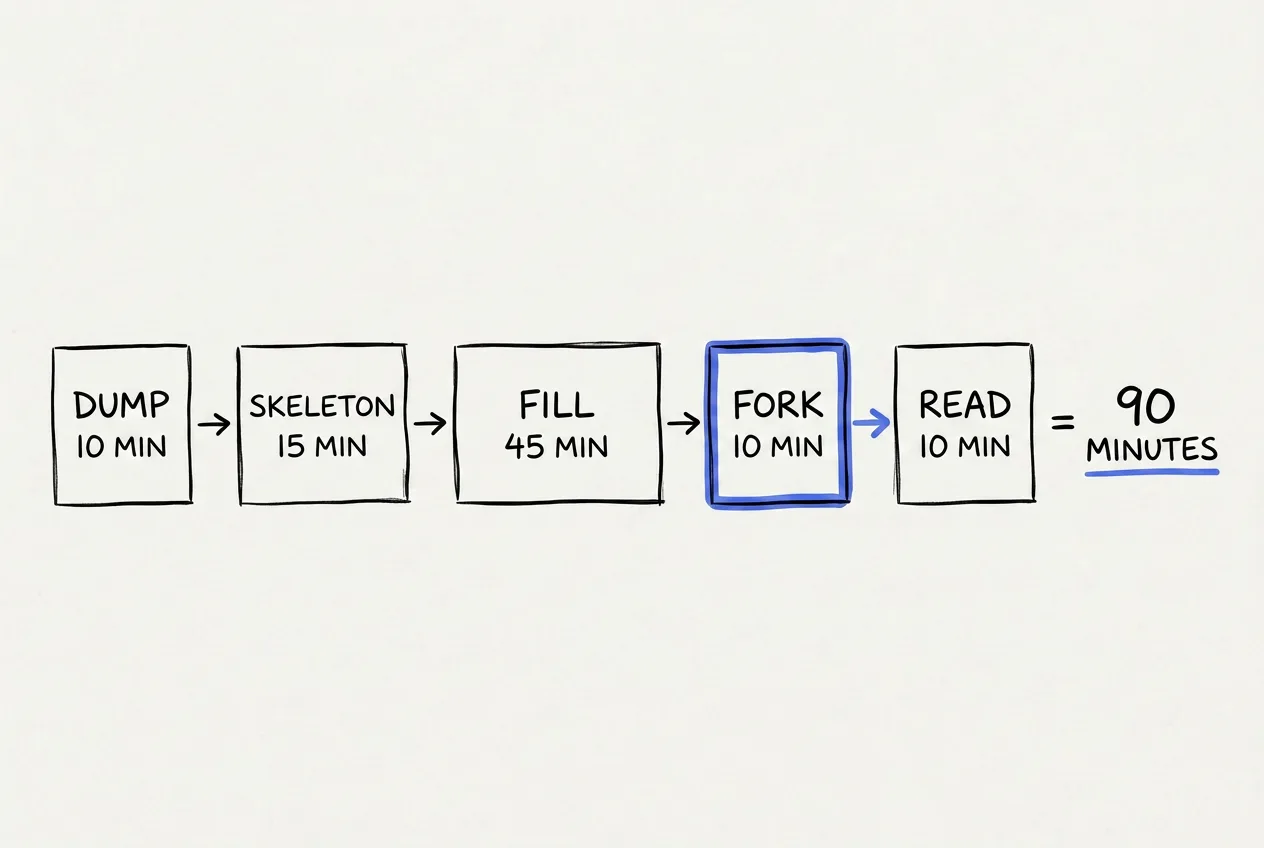
Ninety minutes of writing. The thinking happens in the structure, not the staring.
Our worked example for the whole system is a 10-minute video called "Why your sourdough never rises." That's deliberately not my niche, and probably not yours either, because the point is that the system doesn't care about the topic.
Step 1: Dump (10 minutes)
Collect everything you already know or have saved about the topic into one place. That means comments that asked about it, links you bookmarked, half-formed thoughts, and that one statistic you vaguely remember. Don't write sentences and don't put anything in order. You're emptying your pockets onto a table, nothing more.
For the sourdough video, the dump might be three failed-loaf photos from a forum, a note that "kitchen temperature" is the most-asked question, a link about starter feeding ratios, and the memory of your own first flat loaf.
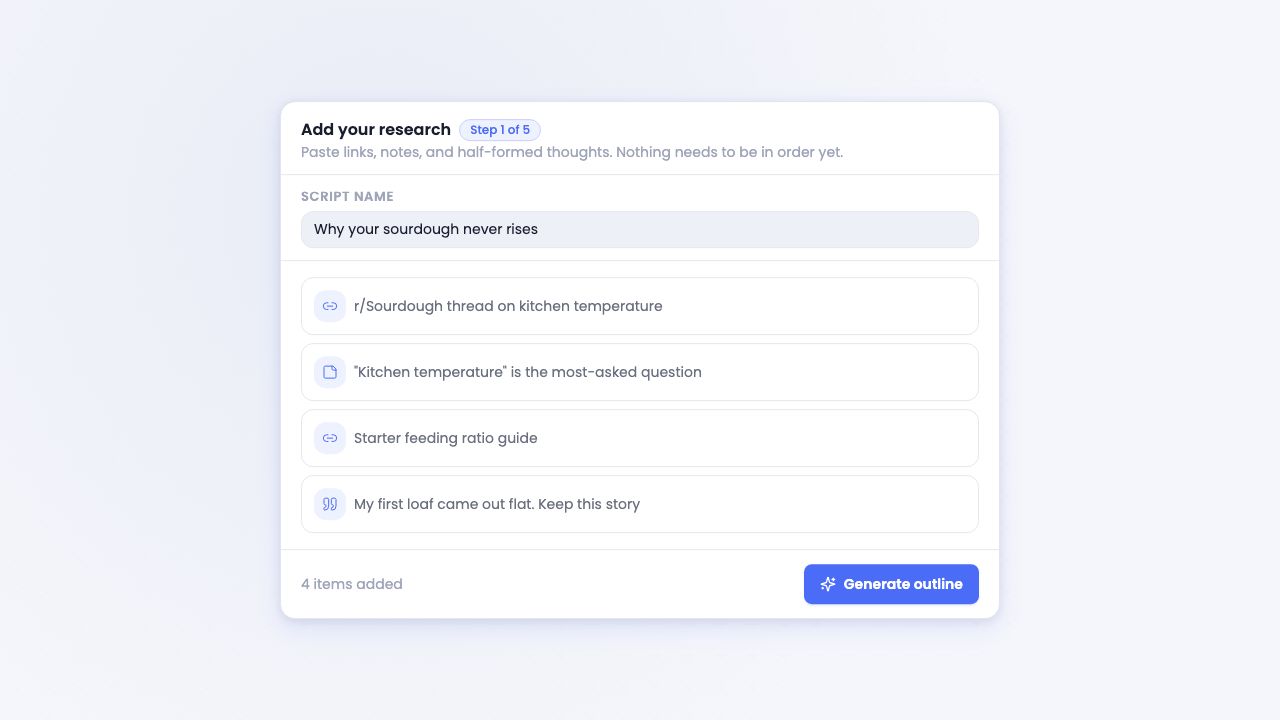
This is the dump step in practice: notes and links go in, nothing gets ordered yet.
There's one rule that makes this step fast: you're not allowed to write prose yet. The moment you start crafting sentences here, you're back to editing in place, just with extra steps.
Step 2: Skeleton (15 minutes)
Now break the video into sections and give each one a single job. For most educational videos between 8 and 20 minutes, that means a hook, something that earns your credibility quickly, three to five body sections, a re-engagement beat near the middle, the payoff, and one call to action. I've mapped that structure in detail in the 7 parts of a high-retention script, but the short list above is enough to work with.
Under each section, write its talking points as commands rather than sentences. "Show the three flat loaves." "Explain the temperature myth." "Reveal the actual cause last." Commands are quick to write, and conveniently, they're impossible to polish.
Then lock the order. Decide once where the reveal lands, and don't renegotiate it with yourself while writing. For the sourdough video, the reveal that "the real cause is your starter schedule, not your kitchen" belongs in section four, so everything before it builds toward that moment and nothing before it is allowed to leak it.
Step 3: Fill (45 minutes)
Now you write prose, and here's the liberating part: you can write the sections in any order you like. Stuck on the hook? Go write section three instead. Because the skeleton already exists, no section depends on the others being finished, so nothing can block anything.
Two numbers make this step feel suddenly manageable. Spoken delivery runs at roughly 140 words per minute, which means a 90-second section is only about 210 words. That's not "write a script." That's the length of a long comment, and you've typed 210 words arguing about pizza toppings without noticing.
As you fill each section, give it its own small arc: open on something unresolved, add the complication in the middle, and land the point at the end. Sections that give away their point too early are one of the big reasons viewers stop watching a video partway through. The sourdough temperature section would open with "everyone blames their cold kitchen, and everyone is almost right," rather than opening with the answer.
Step 4: Fork, don't polish (10 minutes)
Somewhere in the fill, one section came out flat. You already know which one. The instinct is to sand that section until it shines, and that instinct is exactly what used to eat your hours.
So do the opposite. Write two more versions of it, quickly and genuinely differently: if the flat take opened with an explanation, open the next one with the failed loaf story, and the third one mid-action, on day nine when the starter died again. Then compare the three and keep the best one.
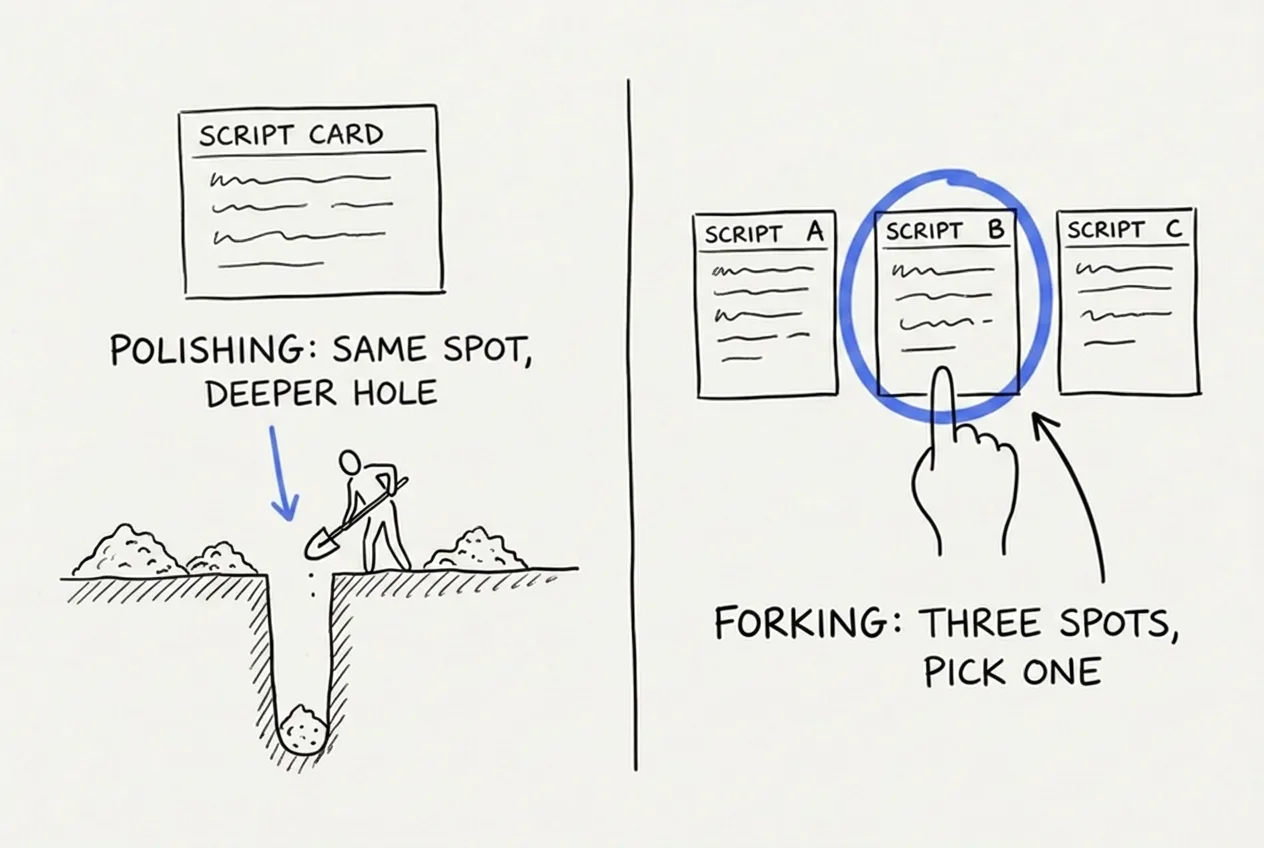
Polishing digs a deeper hole in the same spot. Forking finds a better spot.
This feels wasteful the first time you try it, but it's where all the time comes back. Choosing between three genuinely different takes is a ten-second decision, while polishing a single take goes on for as long as you let it. Forking replaces your slowest activity, which is judgment-free rewriting, with your fastest one, which is picking.
And what about the days when the second and third versions just won't come, because your brain is empty? That's normal, and it's half the reason I built AI variation into my own workflow. A mediocre generated take that you'd never ship still breaks the blankness: you read it, think "no, but," and that "but" turns out to be your version. Writer's block rarely survives contact with a bad draft.
Step 5: Read aloud (10 minutes)
Written English and spoken English are different languages that happen to share words. So read the script out loud once, at full speed, and mark every place you stumble. Contract whatever your mouth naturally contracts, and split any sentence that makes you run out of breath. If a sentence embarrasses you out loud, it will embarrass you on camera too. And if your scripts keep coming out stiff no matter what you do, that's a voice problem rather than a speed problem, and making your scripts sound like you is its own separate fix.
That's the whole system. Ten plus fifteen plus forty-five plus ten plus ten comes to ninety minutes of writing on the clock.
The word-count math for any video length
The 140-words-per-minute rule is worth keeping, because it turns "write a script" into a set of small, known targets. Here's what it looks like for the 10-minute sourdough video:
| Section | Duration | Words |
|---|---|---|
| Hook | 45 seconds | ~105 |
| Credibility beat | 30 seconds | ~70 |
| Body 1: the three usual suspects | 2 minutes | ~280 |
| Body 2: the temperature myth | 2 minutes | ~280 |
| Re-engagement turn | 30 seconds | ~70 |
| Body 3: the starter schedule reveal | 2.5 minutes | ~350 |
| Payoff: the fix, step by step | 1.5 minutes | ~210 |
| CTA | 20 seconds | ~45 |
The total comes to roughly 1,400 words for 10 minutes. Seen as one number, that's intimidating. Seen as eight targets where none is bigger than a long comment, it's a Saturday morning.
The honest math
To be clear about what the ninety minutes covers: it's the writing. The thinking you were already doing all week, in the shower and on your commute, is what steps 1 and 2 harvest. The first couple of times you run this system, expect it to take closer to two hours while the steps still feel new. By your third script, it settles toward the ninety, and the skeleton step alone will feel like cheating.
Now compare that to the four-hour doc. Your words didn't get faster; the structure removed the three culprits. The skeleton killed the blank page, filling in any order killed the linear lock, and forking killed editing in place.
The system doesn't make you write faster. It deletes the parts that were never writing.
What 90 minutes actually assumes
Now for some honesty about that number, because I promised you a system, not a magic trick. Ninety minutes assumes conditions that are rarer than they sound.
It assumes no interruptions, and if you're working a full-time job, even finding an unbroken 90-minute block in your week can be tough before a single word gets written. It assumes your research is already gathered, because the dump step harvests a week of saved links and half-thoughts rather than starting from zero. It assumes you're reasonably quick at turning talking points into sentences. And it assumes you resist the urge to polish at step four instead of forking.
Miss any one of those conditions and the ninety minutes quietly becomes two hours. And then comes the part that makes it genuinely hard: this isn't a one-time performance. You have to find that block, and hold those conditions, every single week, for every new video, for as long as you want the channel to grow.
Why I built ScriptGraph
That gap between the system on paper and the system in a real week is exactly why I built ScriptGraph. It bakes this system into its design: your research dump goes in, the locked skeleton comes out with the talking points already in order, and every section arrives with multiple genuinely different takes, so the fork step is done before you get there. You can regenerate or tweak any one section without touching the others, and your voice carries through all of it.
The result is a film-ready script in about 30 minutes, which happens to be the same promise we make on the ScriptGraph homepage. And most of those 30 minutes is you choosing between takes, which was always the fun part anyway.
The system running itself: dump in, skeleton out, takes ready per section, pick and go.
If you'd like to try it on your next video, learn more here.
Quick answers
How long does it take to write a YouTube script? Without a system, most part-time creators report 3 to 6 hours for a 10-minute video. With the system above, about 90 minutes of writing under good conditions once the steps are familiar. With ScriptGraph doing the heavy lifting, about 30 minutes to a film-ready script.
How many words is a 10-minute YouTube script? About 1,400 words at a natural spoken pace of 140 words per minute. Energetic narrators run closer to 160 and deliberate explainers closer to 120, so read one of your own videos against its transcript to find your true rate before trusting the average.
Now go set a timer. Sourdough optional.
Adi
P.S. If the "fork, don't polish" idea rattled something loose about how you write, the full argument is in you're writing your YouTube scripts wrong.
50%
off · life
Founding Member offer · live now
Script your next YouTube video in 30 minutes
The first 100 subscribers lock in 50% off, for life.
Adi
Founder of ScriptGraph and part-time YouTuber since 2020.
Check out my channel