How to get AI to write YouTube scripts that sound like you
You've probably run this experiment already, because by now everyone has.
You ask an AI for a YouTube script, and what comes back opens with a dramatic one-liner. Short punchy sentences! Stacked for impact! Then comes "But here's the crazy part," and then a rhetorical question you would never ask, all delivered in a voice that belongs to nobody with the enthusiasm of a caffeinated infomercial.
So you either record it and hate yourself a little, or you give up on AI scripts entirely and go back to shipping videos that sound like a stranger borrowed your face.
Here's the thing though: the problem was never that AI can't write in your voice. The problem is that you never told it what your voice actually is, and "write it casual and fun" doesn't count as telling it. This post walks you through the pipeline that actually works. You'll measure your voice, audit it, turn it into instructions, and verify the output against real numbers. It's the same method I built into ScriptGraph, a tool I made for exactly this problem, and you can run every step of it by hand.
Why every AI script sounds the same
A language model with no constraints doesn't write in a neutral voice, because there's no such thing. It writes in the average voice, which is the statistical center of every piece of text it has ever seen. And that center is a real, recognizable register: the punchy fragments, the manufactured hype, the "Let's dive in."
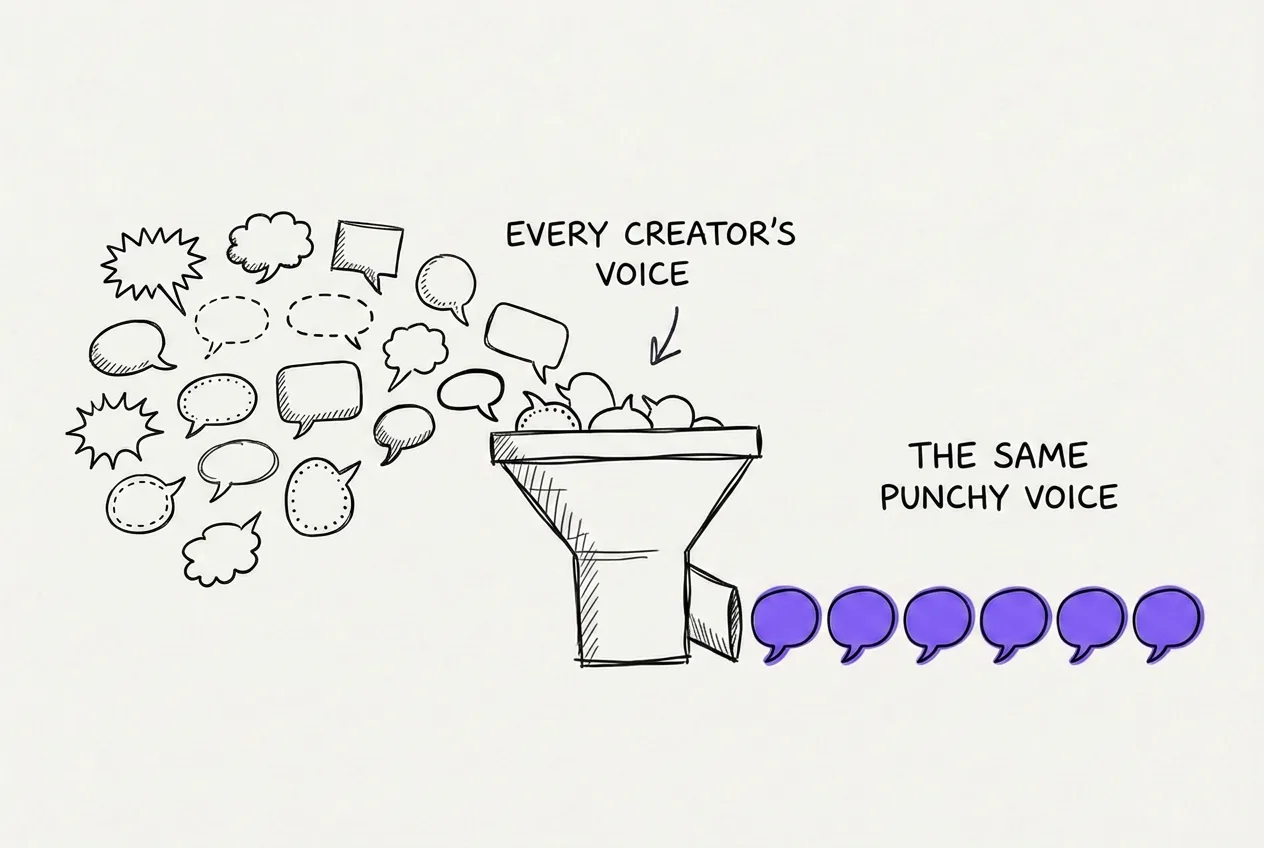
Different creators in, same voice out. The model falls back to the average unless you pin it.
Prompting "casual and conversational" doesn't help, and it's worth understanding why: "casual" describes ten thousand different voices at once. Yours is one specific point inside that cloud, and a vague adjective points at the whole cloud.
Which leads to the sentence this whole post hangs on: if you can't define your voice, you get the average one. Everything below follows from that.
There's one thing worth saying before the pipeline. Voice is the top layer of a script, not the foundation, and it assumes you already have a well-structured video underneath, which is what the complete guide to writing a YouTube script is for. Voice work makes a solid script sound like you, but it can't rescue a shapeless one.
The pipeline: measure, audit, instruct, verify
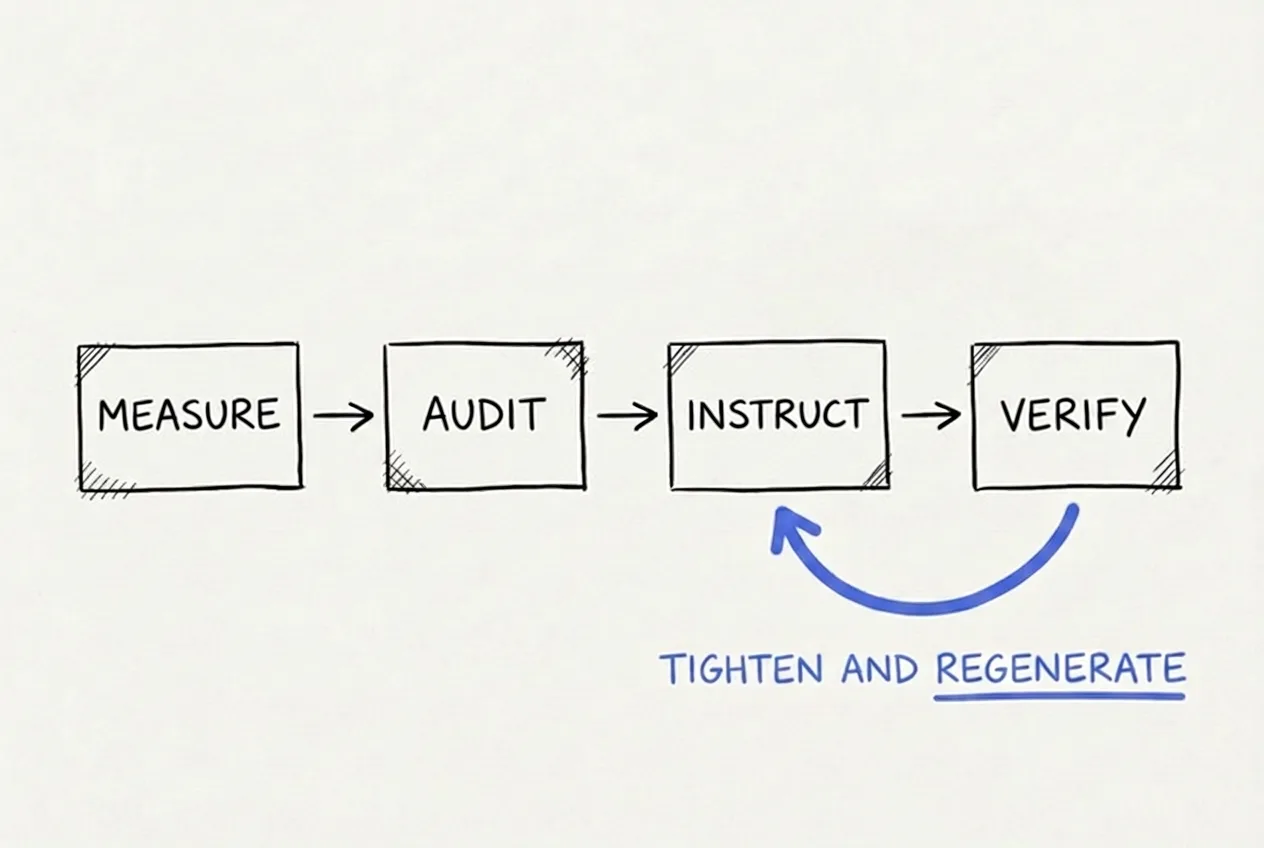
The pipeline. The loop from verify back to instruct is where the magic actually happens.
The setup takes about fifteen minutes, and you only do it once, because the result gets reused for every script you ever generate afterward. Here's each step, by hand.
Step 1: Measure your voice
Grab the transcript of the video, or a sample piece of writing where you sounded most like yourself. Notice that I didn't say your best-performing video; I said your most natural one. Now count six things across a few hundred words of it: your average sentence length, your median sentence length, what percentage of your sentences run under 8 words, how many contractions you use per 100 words, how many questions you ask per 100 sentences, and how often you open a sentence with And, But, or So.
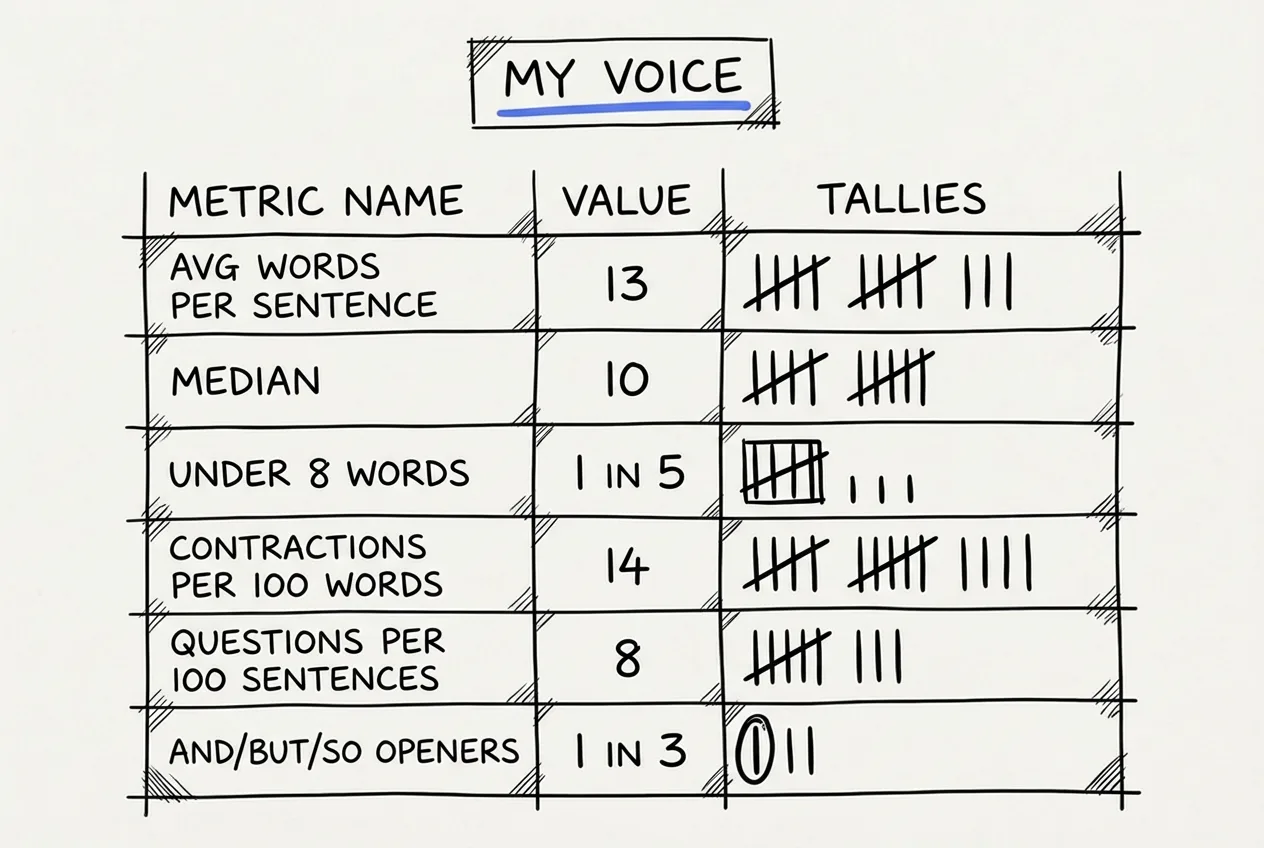
Your voice's skeleton, in six numbers. Tedious to count, impossible to argue with.
This step feels like homework, and I'd encourage you to do it anyway, because these six numbers convert the vaguest thing you own, which is "how I sound," into something an AI can't wriggle out of. A generated draft either averages 13 words per sentence or it doesn't. It either asks questions at your rate or it doesn't.
Step 2: Audit the things numbers can't catch
Read that same transcript again, and this time write down the qualitative stuff. What's your vocabulary level, meaning do you say "utilize" or "use," technical terms or plain words? How do you address people, and how often? What are your rhetorical habits, like repeating things for emphasis, interrupting yourself, calling back to earlier jokes, or reaching for analogies? What are your signature phrases, the two or three things you genuinely say all the time? Keep those verbatim. And where does your energy rise, and where does it stay flat?
Then ask the sharpest question in the whole audit: what do you never do that a generic AI always does? Maybe you never open with a question. Maybe you never say "guys," or never hype a reveal before showing it. That anti-signature matters just as much as your signature, because those are exactly the habits the average voice will try to smuggle back in.
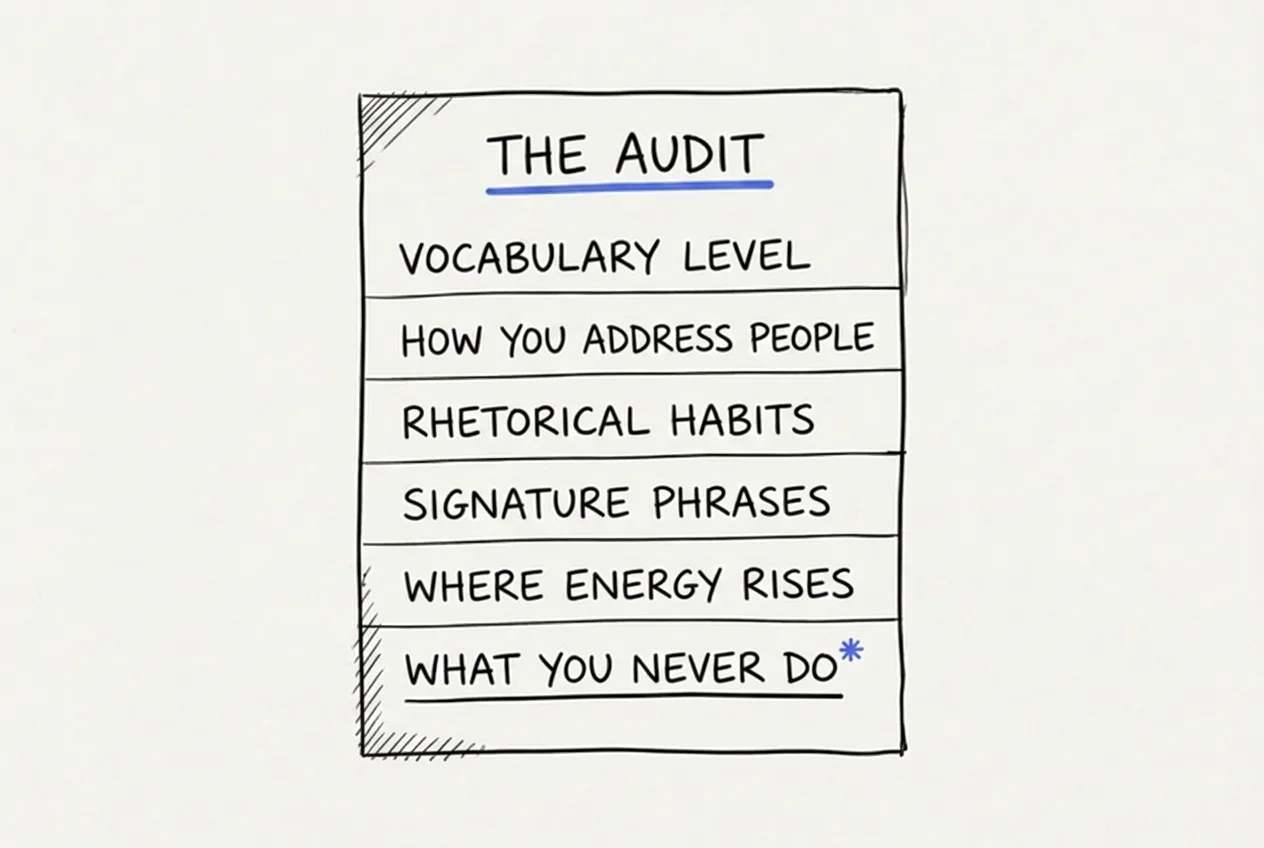
Six things numbers can't catch. The last row is the one people skip, and it matters as much as the rest combined.
Step 3: Write instructions, not descriptions
Now convert everything you've gathered into commands, because this is the step where almost everyone fails. Here's the difference on one card:
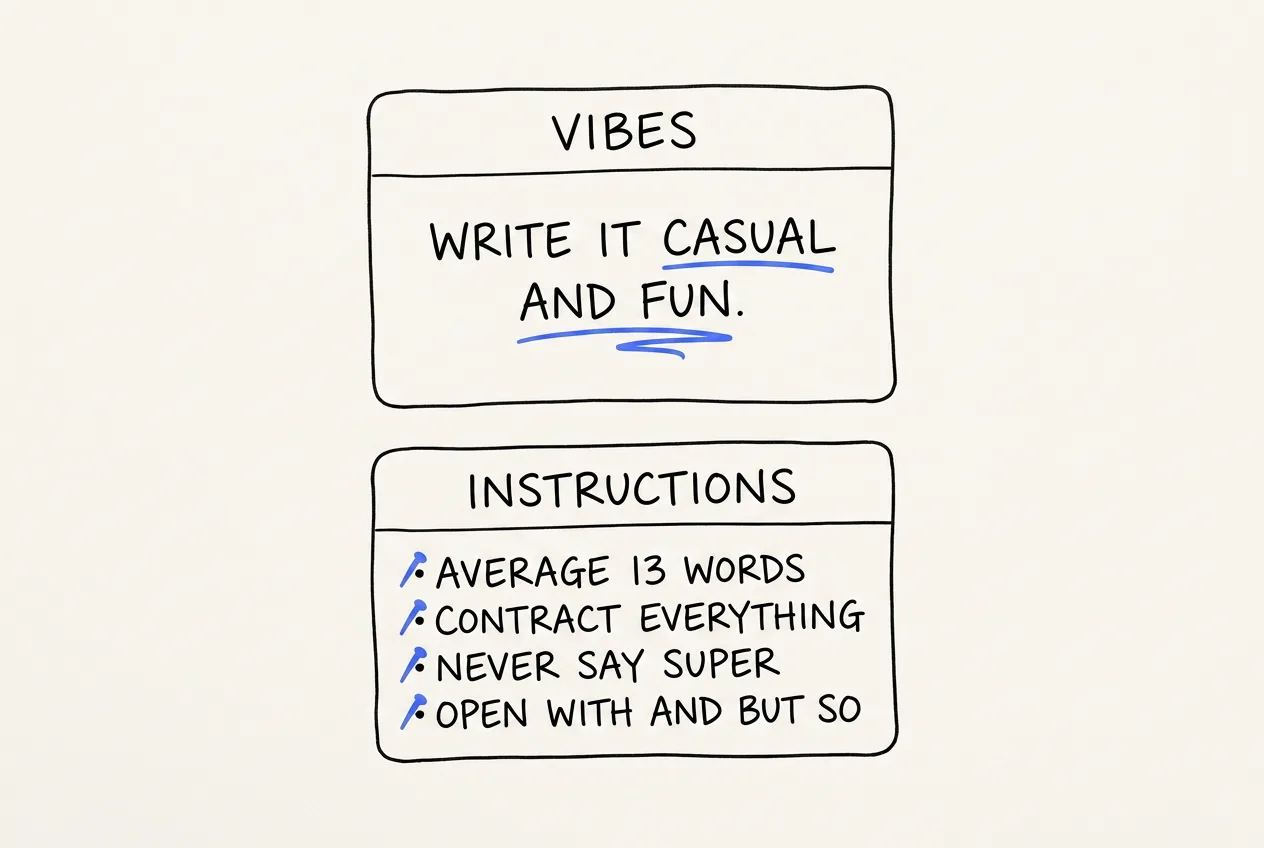
Descriptions produce the average voice wearing a costume. Instructions produce yours.
The vibes version says: "Write in a casual, friendly, conversational tone with short sentences."
The instruction version says: "Average 13 words per sentence, median 10. One sentence in five is under 8 words. Contract everything: I'm, don't, that's. Open roughly a third of sentences with And, But, or So. Ask a direct question about once every 12 sentences. Use 'you' constantly instead of 'we'. Say 'here's my take' before opinions. Never open with a question. Never say 'super' or 'awesome.' Explain jargon in the same sentence it appears."
The first prompt gets you a costume. The second one gets you a ghostwriter, because vague instructions produce generic output while specific ones produce yours.
And in case that still feels abstract, here's the same script beat under each prompt, for a video about batch cooking.
The vibes prompt writes: "Meal prep doesn't have to be overwhelming! With just a few simple hacks, you can transform your entire week. Let's break it down!"
The instruction prompt writes: "So here's my take. You don't have a cooking problem, you have a Tuesday problem. And Tuesday is fixable in about forty minutes on Sunday."
Same beat. One of them is a person.
Step 4: Verify against the numbers
Generate a section, then run the same six counts from step 1 on the output. If the numbers match yours, ship it. If they're drifting, don't start hand-rewriting the draft, because that puts you right back where you started. Instead, tighten the instruction that failed and generate again. If the AI averaged 19 words per sentence against your 13, add a line like "no sentence over 25 words, most under 15" and rerun it.
This loop is the entire trick. Without the verification step, AI voice work is just vibes checking vibes. With it, drift gets caught by arithmetic, and the bar you're aiming for is simple to state and brutal to hit: a subscriber who has watched twenty of your videos shouldn't be able to tell you didn't write it.
The one instruction that fixes half of it
If you only steal a single line from this post, make it this rule for your AI: let the content create the energy, not the punctuation.
The single loudest AI tell is performed enthusiasm, meaning the exclamation marks, the hype adjectives, and the dramatic one-word sentences. Real creators who hold attention do it with material rather than punctuation: the surprising fact carries the excitement, and the delivery stays human. So tell the AI directly that it gets no exclamation marks, no hype adjectives, and no dramatic fragments. If a section turns out boring without the fireworks, the section itself was the problem, and a boring section is one of the surest reasons viewers stop watching. The fix is structural, and it's covered in how I structure videos for retention.
One caveat keeps all of this honest: these rules serve your voice, they don't override it. If you genuinely talk in long flowing sentences, keep them, even though every writing guide on earth says to cut them. Authenticity outranks every rule on this page.
The last two filters
Two final habits protect everything above.
The first is to read it aloud. Written English and spoken English are different languages wearing the same words, and one out-loud pass catches everything the numbers miss: the sentence your mouth refuses to say, the phrase that just isn't you. Mark the stumbles, fix them, and you're done. This pass stays yours forever, because no pipeline replaces it.
The second is to watch for drift over time. Voice matching decays across a long generation, which means section one sounds like you while section six has quietly reverted to the average. That's why the verify step runs per section rather than per script, and it's also why those long one-shot "write me a full video script" prompts sound worse the longer they run. Generate and check in section-sized pieces. As it happens, sections are how scripts should be written anyway, but writing scripts in sections instead of one long document is its own argument.
The honest cost, and what I did about it
Everything above works with any decent AI and a notepad. The catch is that you'll be running the measure-audit-instruct-verify loop for every script, forever, and counting contractions per 100 words on every generated section is nobody's idea of a hobby.
That ongoing tedium is exactly what I automated. ScriptGraph's style extractor runs this pipeline as a feature: paste in one writing sample, and it measures your fingerprint for you, the same six-metric idea but done by code instead of finger-counting. It builds the instruction set from the fingerprint, and then holds every generated section to those numbers automatically. Every take, every regeneration, every AI edit gets checked against your voice instead of drifting back to the average.
Sample in, fingerprint out, and every section after that is held to it.
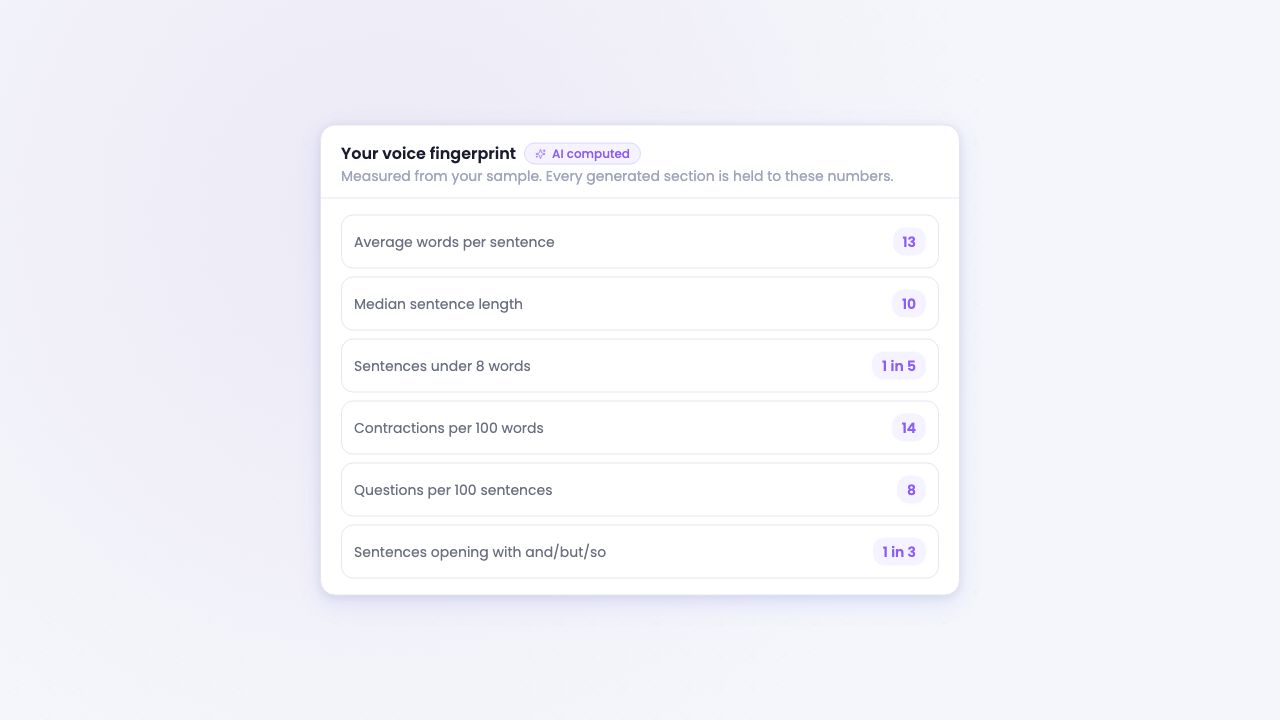
The fingerprint from this post, as a feature. Numbers first, vibes never.
Try it free and bring your most natural transcript.
Quick answers
Why do AI YouTube scripts sound robotic? Two reasons stack on top of each other. Unconstrained models write in the statistical average of every script they've seen, and that average is a real, recognizable hype register. Meanwhile most prompts describe a vibe like "casual and engaging" instead of specifying measurable voice traits, so the model fills the gap with that average. Robotic is simply what unspecified sounds like.
Can AI actually write in my voice? Yes, to the point where regular viewers can't reliably tell, but only if the voice is defined as instructions and checked with numbers. What AI can't do is know your voice without being shown it, or hold that voice over long generations without per-section verification. Define it, instruct it, verify it, and skip any of the three and the average creeps back in.
So no, AI doesn't have to sound like a caffeinated infomercial. Your voice is six numbers and a page of habits, and once you've written those down and made the AI prove itself against them, what comes back finally sounds like you. That's the whole pipeline, and you only have to build it once.
Adi
P.S. If you're still writing everything by hand and just want the faster manual method, start with the 90-minute script system instead.
50%
off · life
Founding Member offer · live now
Script your next YouTube video in 30 minutes
The first 100 subscribers lock in 50% off, for life.
Adi
Founder of ScriptGraph and part-time YouTuber since 2020.
Check out my channel