How to write a YouTube script: the complete system, with a template
Most YouTube scripts fail before a single word gets written.
That's not because the writing is bad. It's because the writer sat down to "write the video" the way you'd write an essay, starting at the top, describing the topic, and wrapping up with a conclusion. The trouble is that viewers don't watch essays. They watch promises being kept, slowly, with tension in between.
This post is the complete system I use to script long-form videos, from the first idea to the final read-through. It's long on purpose, so bookmark it, use the template at the bottom, and branch out to the deeper guides as you need them. By the end you'll have the mindset shift that separates scripts from essays, the pre-writing contract that decides most of your retention, the 7-part structure of a high-retention video with its timing math, the way to write each part, a fully worked example, and a copyable template.
A script is an engineered structure, not prose
Here's the reframe that everything else depends on: a YouTube script is really two jobs, done by two different people who happen to share your body.
The first person is an architect. They decide the video's structure, meaning what gets promised, where tension builds, where the payoffs land, and what order the reveals arrive in. The second person is a writer, and they fill that structure with sentences that sound like you.
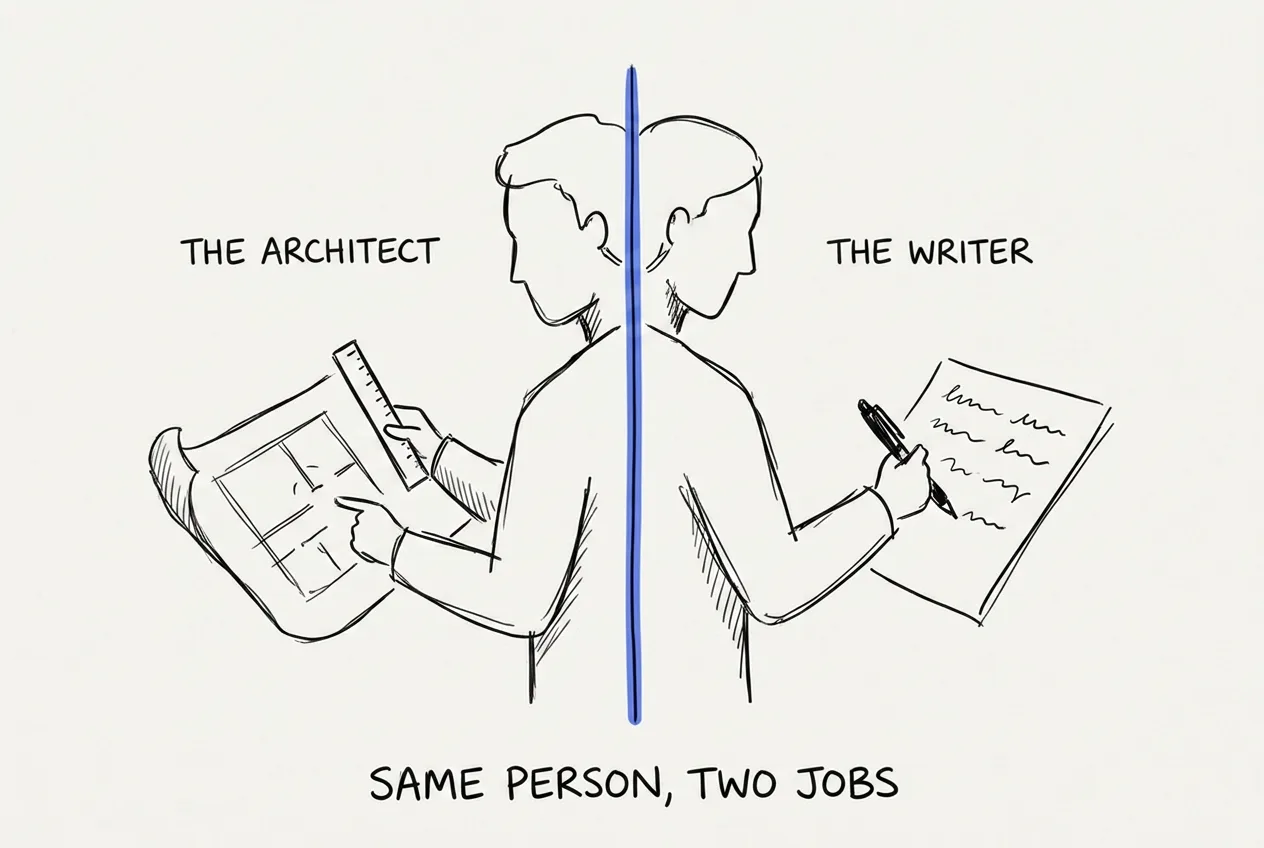
Same person, two jobs. Most scripts go wrong because the writer showed up alone.
When scripts go wrong, it's almost always because the writer showed up without the architect. You start typing, the structure assembles itself by accident, and the retention graph later shows you exactly where the accident happened. I've written a whole guide on reading those graphs, but the short version is worth stating here: structure failures, not sentence failures, are what make people leave.
So we do the architect's job first, and it's faster than it sounds.
Before you write: the contract
Every video makes a contract before it plays a single frame. The title and thumbnail promise something, and the video's job is to keep that promise. Scripts that ignore this get punished in the first 30 seconds no matter how good the writing is.
So before outlining anything, answer two questions on paper.
The first is: what is the one thing this video delivers? And I do mean one. A video about "morning routines, productivity, and why I quit coffee" is three contracts at once, and it will keep none of them. Distill your video down to a single core takeaway you could say in one sentence.
The second is: what does the viewer expect after seeing the title and thumbnail? Write down the two or three questions a clicking viewer is silently asking. If your title is "I tested every budget microphone," they're asking which one won, how bad the cheap ones really are, and what they should buy. Your script has to answer those questions, and your hook has to signal early that it will.
This exercise takes five minutes, and it's the highest-value five minutes in the whole system, because everything downstream inherits from it.
The architecture: the Retention Blueprint
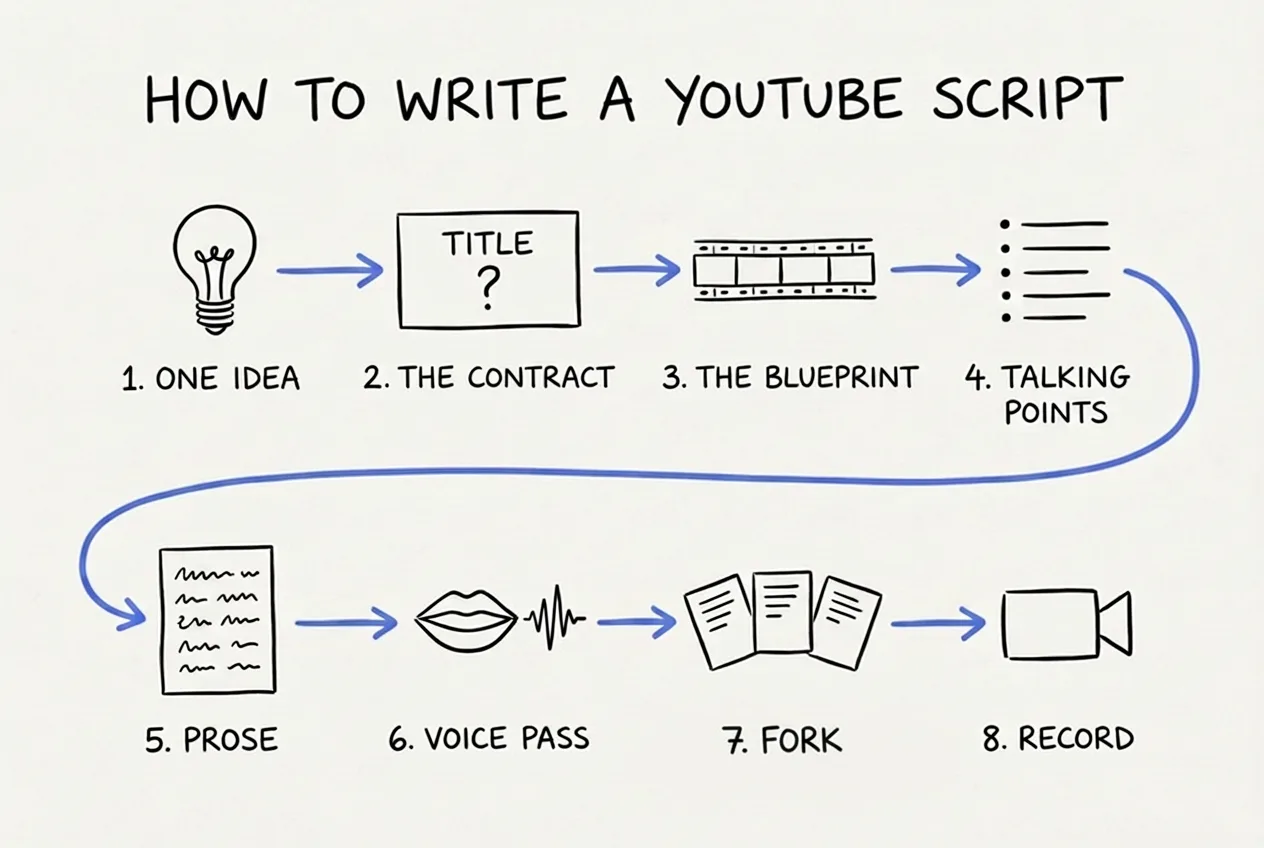
The whole system on one page. The rest of this post walks it left to right.
High-retention videos in the 8 to 20 minute range keep converging on the same skeleton, which I call the Retention Blueprint. It has seven parts, or more precisely seven part types, because the body repeats: a tight video might be five sections while a dense one is twelve, and the roles stay constant while the count belongs to the video. The full framework, with a real 27-million-view video mapped onto it, lives in the 7 parts of a high-retention script. Here's the working summary.
- The hook (30 to 60 seconds) confirms the click, with a promise, stakes, and one opened question.
- The credibility bridge (30 to 60 seconds) gives one concrete reason to trust you, like a result, a number, or a named experience. It's not a bio.
- The open loop plant (optional) explicitly teases the best thing coming, for when the hook doesn't naturally carry one.
- The main body (3 to 5 sections, at least half your runtime) is the actual content, with one claim per section.
- The re-engagement beat (at the 50 to 60% mark) is a planned moment that re-hooks whoever's drifting.
- The payoff closes every open question and lands the takeaway.
- The CTA (under 30 seconds) makes exactly one ask.
The timing math matters as much as the order. Spoken delivery averages about 140 words per minute, so budget your sections in words before you write them. Two rules keep the shape honest: the hook and bridge together get at most 15% of the runtime, and the main body gets at least half. For a 12-minute video, the budget works out like this:
| Part | Duration | Words |
|---|---|---|
| Hook | 50 seconds | ~115 |
| Credibility bridge | 30 seconds | ~70 |
| Body section 1 | 2 minutes | ~280 |
| Body section 2 | 2.5 minutes | ~350 |
| Re-engagement | 30 seconds | ~70 |
| Body section 3 | 2.5 minutes | ~350 |
| Body section 4 | 2 minutes | ~280 |
| Payoff | 1 minute | ~140 |
| CTA | 20 seconds | ~45 |
That's roughly 1,700 words in total, and the framing matters: it's not one intimidating script, it's nine small targets.
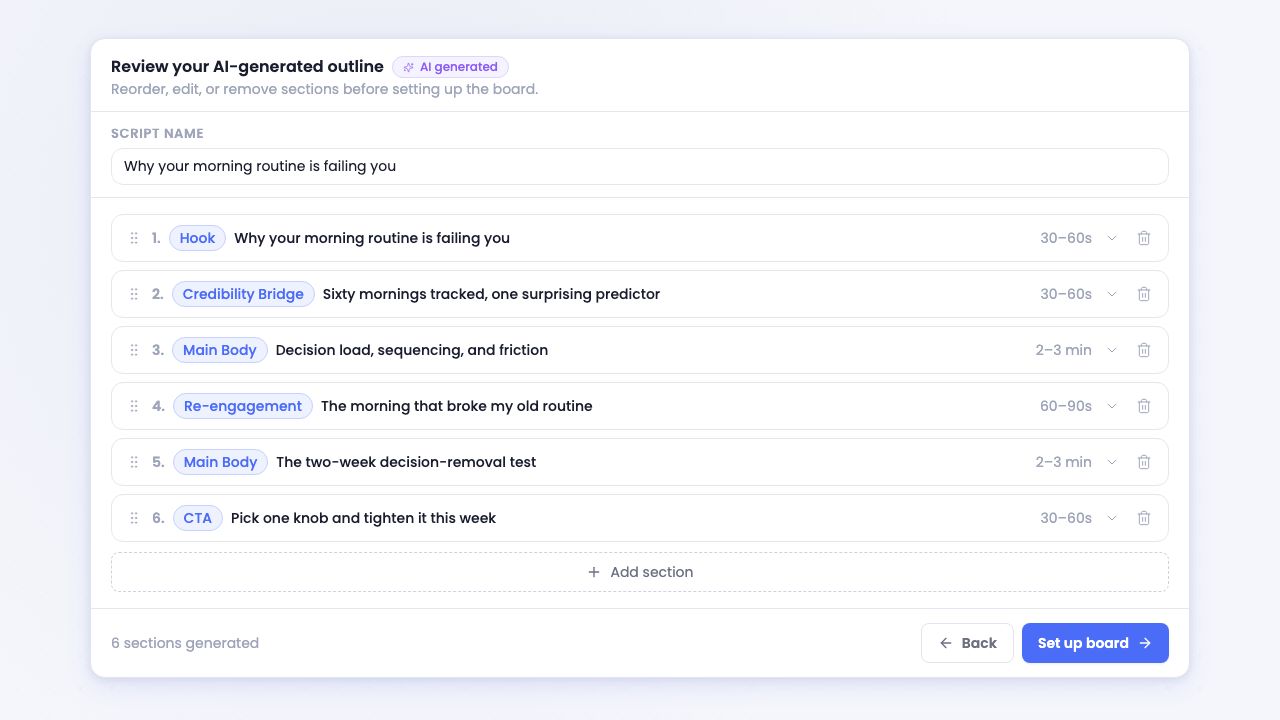
The same budget, done automatically. This is ScriptGraph's outline step, the tool I built.
Writing each part
The hook: confirm the click
Your first two sentences either validate the viewer's decision to click or they lose them. Mirror the title's promise without repeating it word for word, raise the stakes, and open a question that the video will answer. Start mid-conversation, with no channel intro, no "hey guys, welcome back," and no throat-clearing. There's a whole craft in here, and I've dissected six real hooks line by line if you want the frameworks, but the minimum bar is promise, stakes, and an open question, all inside 30 seconds.
The credibility bridge: earn the next ten minutes
Give one concrete credential, fast. "I've edited 200 videos for channels you've watched" beats two minutes of backstory every time. The bridge exists to answer the viewer's quiet "why should I listen to you?" and then get out of the way. And if you don't have a credential yet, borrow one honestly, because "I spent three weekends testing this so you don't have to" is a credential.
Open loops: the thread that pulls
An open loop is a promise of a payoff at a known-later point, something like "the third mistake is the one that nearly ended my channel." Plant your most valuable one in the first third of the video, close it in the final third, and let every body section end by opening the next. Loops are the single strongest retention device in scripting, strong enough that they get their own guide. The one iron rule: every loop you open, you close, because unclosed loops read as betrayal and viewers remember.
Main body sections: the trick inside every section
Each body section makes one claim, explains it, and backs it with a specific example or story. Never put two claims in one section; split them instead.
Then there's the trick most creators never find, which is that every body section runs its own tiny hook, tension, and payoff arc. Open the section on something unresolved. Build the complication through the middle. Land the point at the end, not at the top, because if you front-load the section's conclusion and then explain backwards, viewers skip ahead at every reveal and your retention graph grows sawteeth. The gap between a claim and its proof is what keeps people watching, so hold that gap open on purpose.
Each section also needs a delivery style matched to its content: a story that builds to a reveal, a list where every item stands alone, an analogy that anchors something unfamiliar, a tutorial in strict step order, or a direct argument that proves its claim immediately. Most videos mix two or three of these.
And one more time, because it's the most common mistake: end every body section by opening the next one. A section that wraps up neatly is a polite exit sign.
Re-engagement: the midpoint rescue
Attention bottoms out just past the middle of every video, so plan for it rather than hoping. At the 50 to 60% mark, close an earlier loop and immediately open a new one, or drop a reframe that recontextualizes everything so far, or address the viewer directly. Done well it feels like a reward for staying and a fresh reason to keep staying, delivered in the same breath.
Payoff: keep the promise
Close every remaining loop and deliver the thing the title sold. Nothing new gets introduced here, because this is where the video consolidates, lands, and leaves the viewer with one memorable sentence they could repeat to a friend. If they can't summarize your video in a sentence afterward, the payoff didn't land.
CTA: one ask
Just one. Subscribe, or watch the next video, or grab the download, and tie it to the value they just received, something like "if this fixed your intro, the retention deep-dive is next." Every additional ask weakens all of them, so keep it under 30 seconds and then stop talking.
Plan in talking points, then write prose
Here's the workflow habit that connects the architecture to the actual writing: fill the skeleton with talking points before you write any prose. Talking points are commands rather than sentences, things like "Show the failed attempt," "Explain the 140 words-per-minute rule," and "Reveal the winner last."
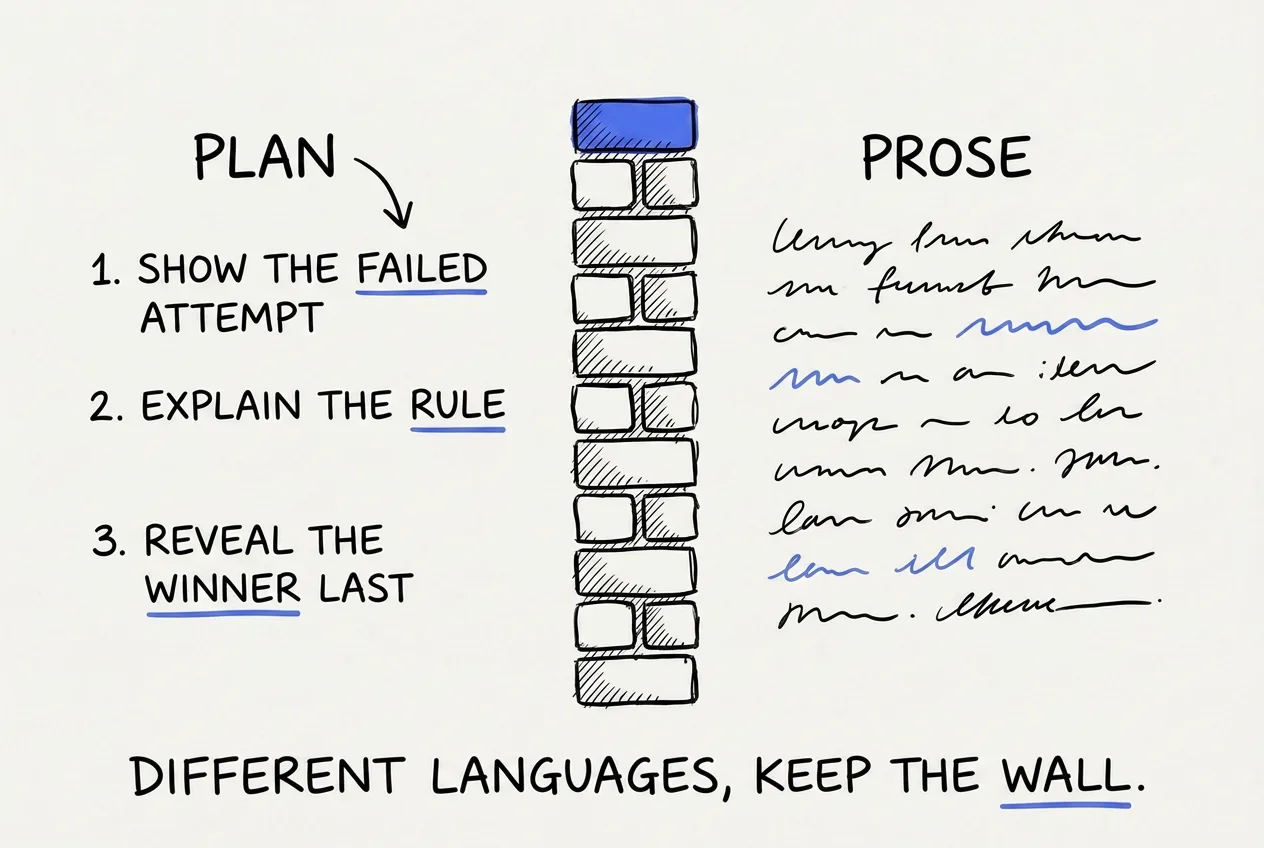
Planning language and script language are different languages. The wall between them is the workflow.
Two rules make this step powerful. First, be specific: "mention the $40 mic beat the $300 one" and not "talk about results." Second, lock the order. Decide once where each reveal lands, and never leak it earlier while writing. That locked order is also what lets you write sections in any sequence, and even swap alternative takes of a section without breaking the video's logic, which is the core idea behind how I think scripts should be written at all.
Talking points, locked and ordered. This is the outline step in ScriptGraph, right before the prose gets written.
Once the talking points exist, write the prose fast, section by section, in whatever order unblocks you. The full time-boxed method for that is the 90-minute script system.
The voice pass
A structurally perfect script read in a stranger's voice still dies, so run two filters before you record. First, read the script aloud and fix every stumble, because written English is not spoken English and your mouth will find the lies your eyes missed. Second, check that it sounds like you rather than like "a YouTuber," meaning your sentence lengths, your phrases, and your energy. Don't perform excitement with punctuation; let the material carry it. And if you're generating any of the script with AI, voice becomes its own discipline, and here's the full pipeline for that.
A worked example: the skeleton in the wild
Let's put the whole system to use by drafting an outline for an imaginary 12-minute video called "Learning guitar as a busy adult: the 20-minute system." The core takeaway, in one sentence: short daily practice beats weekend marathons. The viewer questions hiding in the title: does 20 minutes actually work, what do I practice, and how long until results?
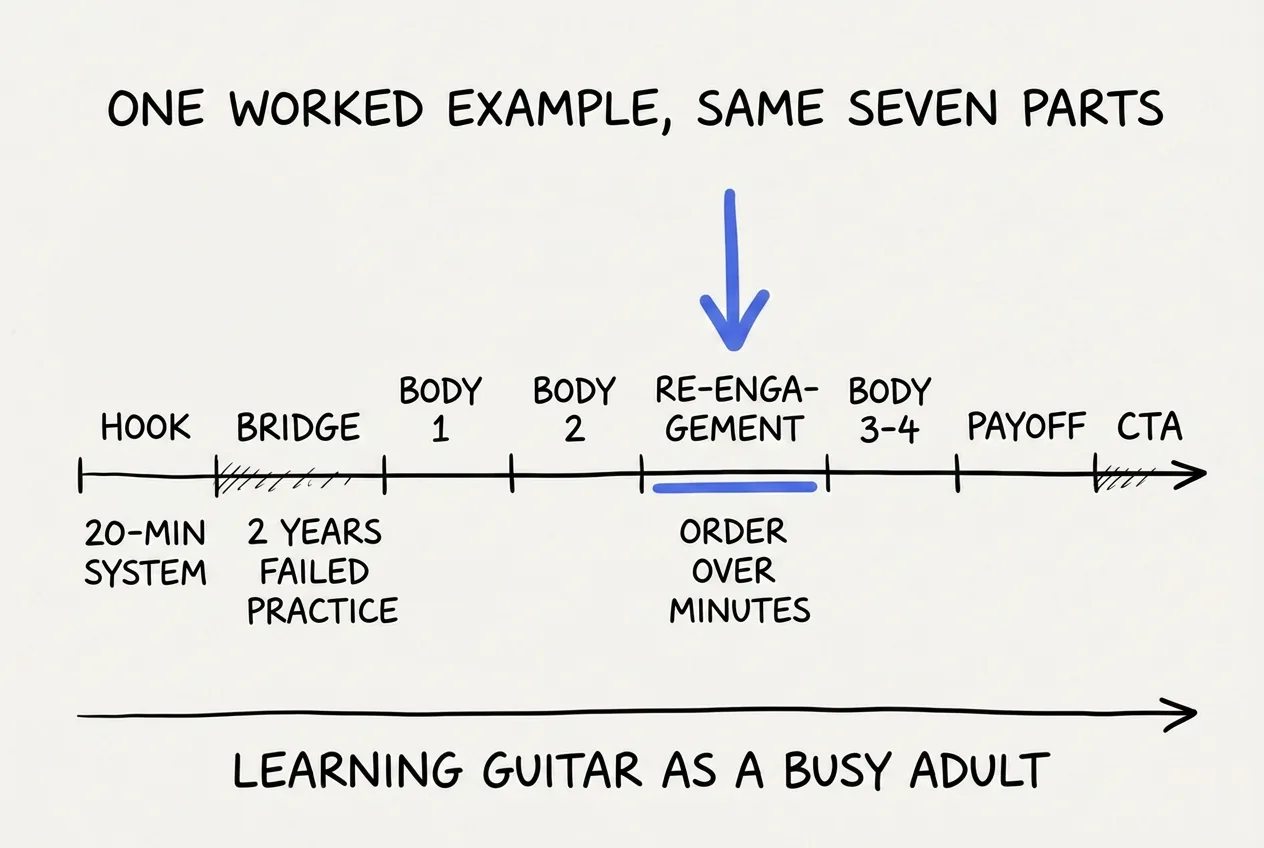
The same seven parts, one worked example. The re-engagement beat is where the ordering payoff lands.
Here's the skeleton, written as talking points.
The hook (50 seconds) validates the click first by restating the title's promise, an exact 20-minute system for busy adults, then signals that the viewer's questions are all coming: what to practice, in what order, and how fast results arrive. It sets the stakes with the fact that most adult learners quit by month three, and plants a loop: "the third exercise is the one guitar teachers hate."
The bridge (30 seconds) offers one line of honest credibility, two years of failed weekend practice followed by 14 months of this system, with before-and-after clips as proof.
Body one (2 minutes, told as a story) covers why weekend marathons fail and ends by opening the next section: "so I stole a trick from language learners."
Body two (2.5 minutes, as a tutorial) walks the 20-minute structure minute by minute and ends with "but the order matters more than the minutes."
The re-engagement beat (30 seconds) closes that loop with the counterintuitive ordering and opens the last one: "which brings us to the exercise teachers hate."
Body three (2.5 minutes, direct argument) delivers the controversial exercise with immediate proof, and body four (2 minutes, story) runs month by month through what changed, honest plateaus included.
The payoff (1 minute) puts the system on one screen and lands the repeatable sentence, "twenty focused minutes beats two distracted hours."
The CTA (20 seconds) makes one ask, tied to downloading the practice sheet.
Given this outline, writing each section of the script should be a lot easier, and come a lot more naturally to you. To show you an example of what that would look like, here's the hook written out as prose, so you can see talking points become script:
You really can get good at guitar on twenty minutes a day, even as a busy adult, and in the next twelve minutes I'll hand you the exact system: what to practice, in what order, and what results to expect month by month. Fair warning on the stakes, though: most adults who pick up a guitar quit by month three, and it's rarely a talent problem. It's the practice schedule. Oh, and the third exercise in the system is the one guitar teachers genuinely hate.
That's a few sentences doing the hook's whole job in well under a minute: the click validated straight away, every question the title raised now scheduled for an answer, the stakes made real, and a loop opened.
That hook, generated from the talking points above. This is the generate step in ScriptGraph.
The template
Copy this for your next video. Fill in the brackets, respect the budgets, and write the talking points before the prose.
VIDEO: [title]
CORE TAKEAWAY (one sentence): [...]
VIEWER QUESTIONS FROM THE TITLE: 1. [...] 2. [...] 3. [...]
TARGET LENGTH: [N] minutes (~[N x 140] words)

HOOK (30-60s, confirm the click):
- promise: [...]  - stakes: [...]  - loop opened: [...]
CREDIBILITY BRIDGE (30-60s): [one concrete credential]
BODY 1 ([time], [story/list/analogy/tutorial/direct]):
- claim: [...] - points in order: [...] - ends by opening: [...]
BODY 2 (...): [...]
RE-ENGAGEMENT (at ~55%): [close which loop, open which]
BODY 3-4 (...): [...]
PAYOFF: [loops to close: ...] [the repeatable sentence: ...]
CTA (under 30s): [the one ask]
Quick answers
Should I script word-for-word or use bullet points? Script word-for-word if you're newer, if precision matters, or if you edit heavily, because it gives you the voice pass and cuts your filming time. Bullets start working once you can hold a section's arc in your head without rambling. Either way, the structure above doesn't change; only the prose step does.
How long does it take to write a YouTube script? With this system, about 90 minutes of writing for a 10-minute video under good conditions, once you've run it a few times. The timed breakdown is here.
How long should a YouTube video be? As long as the content stays dense, and not a minute longer. The structure scales in both directions, so a 6-minute video might run hook, bridge, two bodies, payoff, and CTA. Length should follow the content budget, never the other way around.
Do I need a script for vlogs? A full word-for-word script, rarely. The contract and the skeleton, always. Even a vlog earns its retention through a promise, escalation, and a payoff; you can improvise sentences, but you can't improvise structure.
Where this all goes
You now have the whole system: the contract, the Blueprint, talking points, prose, and the voice pass. It's everything I do, and every step of it works in an ordinary doc.
It's also, frankly, a lot of moving parts to carry by hand, for every script you ever write. The system compounds over months of videos, and that's precisely when hand-carried discipline starts to slip, which is why I built ScriptGraph to carry it instead. Drop in your idea and research, and it produces the Blueprint skeleton with every section labeled by its job and its talking points in order, writes voice-matched takes for every section, and assembles the path you choose into a finished script.
The system in this post, running end to end: idea in, structured script out.
If you'd like to try it on your next video, you can learn more here.
So don't sit down to write the video next time. Sit down to design it first, fill the skeleton with talking points, and then let yourself write fast inside a structure that's already doing the retention work. That's the entire difference between a script that holds people and an essay that loses them.
Adi
50%
off · life
Founding Member offer · live now
Script your next YouTube video in 30 minutes
The first 100 subscribers lock in 50% off, for life.
Adi
Founder of ScriptGraph and part-time YouTuber since 2020.
Check out my channel